


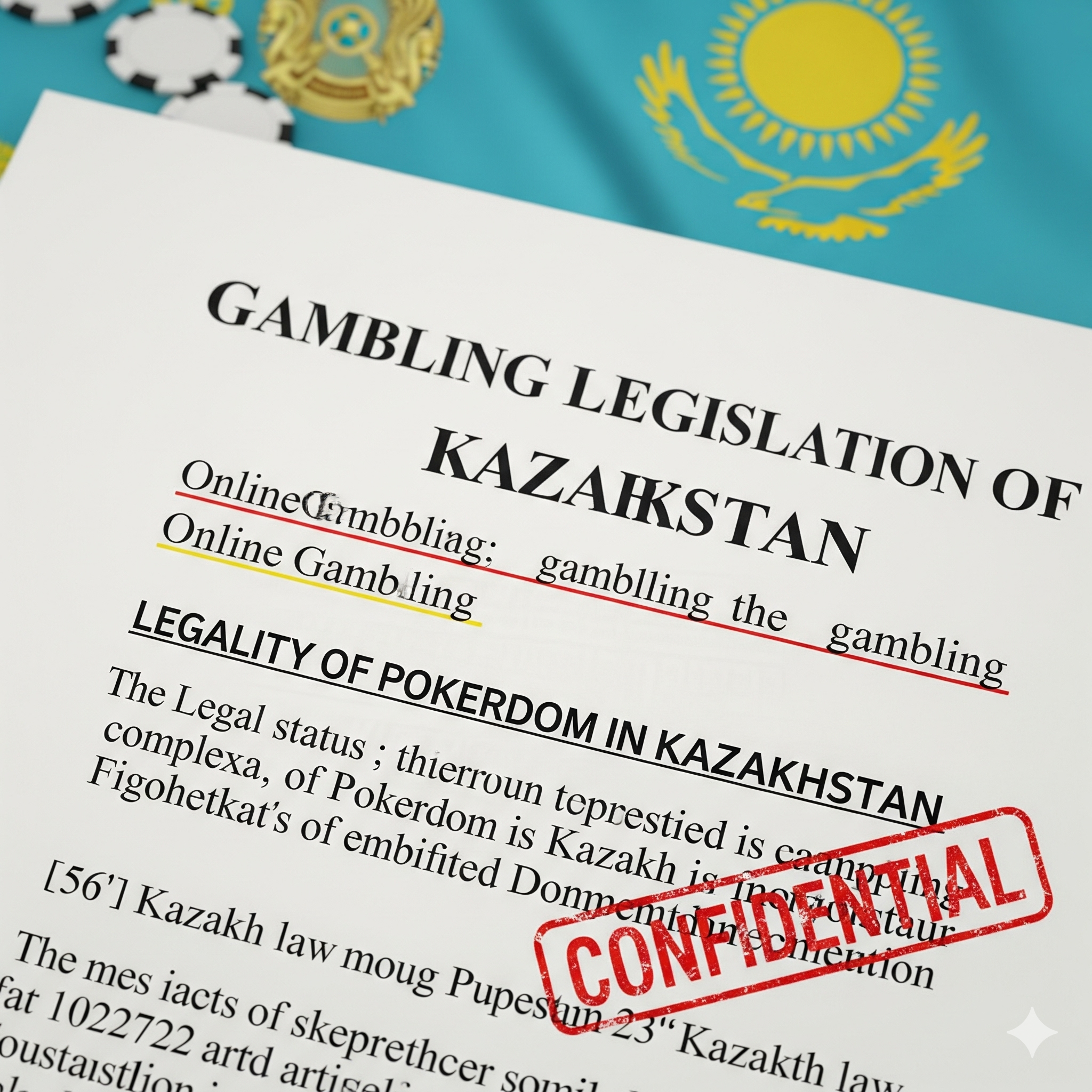
Pokerdom Kazakhstan legality — one of the most relevant questions for Kazakhstani players interested in online poker and gambling. The platform operates based on an international Curacao eGaming license, which ensures compliance with global standards of fairness and security, however the local legislation of the Republic of Kazakhstan has its own peculiarities in regulating gambling activities. Is Pokerdom legal in Kazakhstan — this question requires detailed consideration of current legal norms and practices of their application.
Online poker Kazakhstan law regulates through the “On Gambling Activities” Law from 2007 with subsequent amendments, which establish special zones for conducting gambling business and restrictions on online operations. Gambling business Kazakhstan is allowed only in special economic zones, while the status of international online platforms remains in a legal “gray area”. It is important to understand the differences between organizing gambling business and participating in games as an individual, since responsibility can differ significantly.
Current legislation of Kazakhstan on gambling activities
The legislative base of the Republic of Kazakhstan in the sphere of gambling activities is based on the “On Gambling Activities” Law from December 11, 2007, which establishes an exhaustive list of permitted forms of gambling and places for their conduct. The law clearly distinguishes between the concepts of organizing gambling business and participating in gambling, which is critically important for understanding the legal status of players.
Special gambling zones and their significance
According to current legislation, gambling activities in Kazakhstan are permitted exclusively on the territory of special gambling zones. Currently, zones “Kapchagai” in Almaty region and “Shchuchinsk” in Akmola region are functioning. These territories have a special legal regime allowing legal conduct of activities for organizing and conducting gambling.
An important aspect is that the law regulates precisely the organization of gambling business on the territory of Kazakhstan, but does not contain direct prohibitions on citizens’ participation in online games on international platforms. This legal collision creates uncertainty in the interpretation of the law regarding players using foreign gambling sites.
Internet and online games in the context of the law
The “On Gambling Activities” Law was adopted in 2007, when online games did not have modern distribution, therefore direct regulation of internet poker and online casinos is practically absent in the document. Amendments of 2012 and 2018 partially addressed internet resource issues, but the main emphasis was placed on blocking sites, not on pursuing players.
Roskomnadzor of Kazakhstan (Information Committee) periodically blocks access to gambling sites, however practice shows that most international operators use mirrors and VPN technologies to ensure access. Law enforcement practice does not contain precedents of holding ordinary players accountable for participating in online games.
Taxation of gambling winnings
The Tax Code of the Republic of Kazakhstan establishes the obligation to declare and pay income tax on winnings from participating in gambling. The tax rate is 10% on the amount of winnings exceeding 342 times the monthly calculation indicator (MCI). In 2025, the non-taxable minimum amounts to about 1.1 million tenge.
It is important to note that the tax obligation arises regardless of where the winnings were obtained — in a legal gambling zone of Kazakhstan or on an international online platform. Concealing income from winnings may result in administrative or criminal liability depending on the amount.
| Regulation aspect | Legislative base | Application practice | Risks for players |
|---|---|---|---|
| Gambling business organization | Only in special zones | Strict prosecution | Does not concern players |
| Participation in online games | Not directly prohibited | Site blocking | Minimal |
| Taxation of winnings | 10% above 1.1 million ₸ | Control is strengthening | When concealing income |
| Site blocking | By court decision | Active application | Technical inconveniences |
- Gambling activities are allowed only in special zones “Kapchagai” and “Shchuchinsk”
- There is no direct prohibition on citizens’ participation in online games
- 10% tax on winnings above 1.1 million tenge is mandatory
- Site blocking is practiced, but bypassed by technical means
- Law enforcement practice does not pursue ordinary players
- Responsibility for organizing illegal gambling business is serious
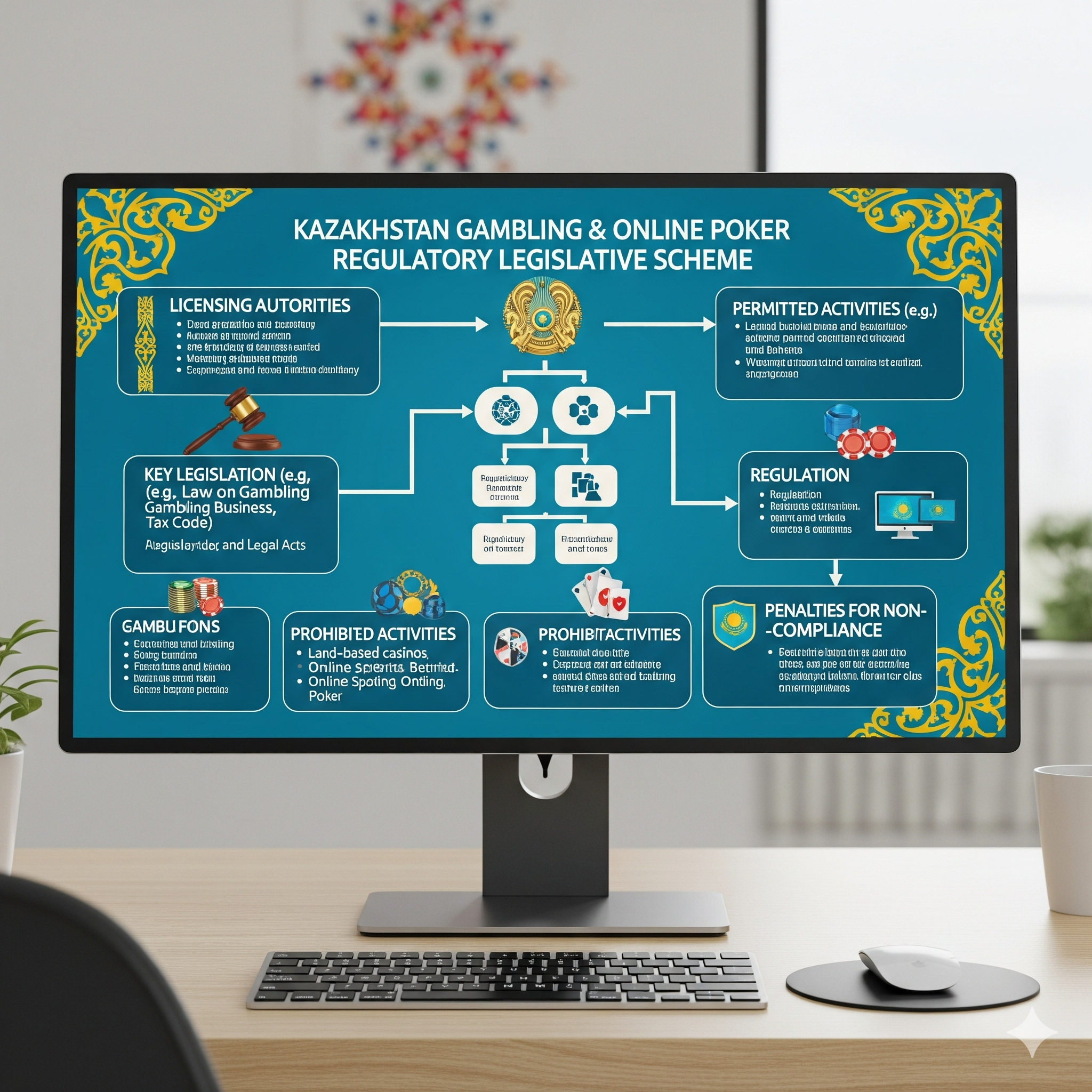
Licensing and international standards of Pokerdom
Pokerdom Kazakhstan license is issued by the government of Curacao under number 8048/JAZ2020-13, which ensures compliance with international standards of responsible gaming, player protection and fairness of the gaming process. Curacao is one of the most authoritative jurisdictions in the field of online gaming with strict requirements for operators.
Requirements of Curacao eGaming license
License requirements include mandatory use of certified random number generators (RNG), conducting regular audits by independent companies, segregation of player funds from operational capital and compliance with AML/CFT standards (anti-money laundering and counter-terrorism financing).
Operators are obliged to implement responsible gaming tools: deposit limits, playing time limits, self-exclusion and early detection systems for problematic behavior. Regular activity reports are submitted to the Curacao Gaming Commission monthly. Violation of license conditions results in fines, suspension or revocation of the permit.
International certifications and audits
Pokerdom undergoes regular audits by international organizations eCOGRA (eCommerce Online Gaming Regulation and Assurance) and iTech Labs, which confirm the fairness of the gaming process and compliance with stated RTP (return to player) indicators. Certificates are published in open access and updated annually.
Gaming Laboratories International (GLI) tests gaming software for compliance with international standards of randomness and fairness. BMM Testlabs conducts verification of security systems and player data protection. All certificates are available for review in the “Licenses and Certificates” section on the official website.
Player fund protection and insurance
In accordance with license requirements, all player funds are stored in segregated accounts in reputable European banks, completely isolated from the company’s operational capital. Additionally, deposit insurance through Lloyd’s of London operates for a total amount of 50 million US dollars.
The financial transaction monitoring system operates in real-time, tracking suspicious transactions and blocking fraud attempts. All player data is protected by modern encryption and is not transferred to third parties without account holder consent.
“The international Curacao license provides players with guarantees of fairness and security at the level of world standards. Regular audits by independent organizations confirm that all games are truly random and fair.” — Gaming Laboratories International representative.
| Certificate/License | Issuing organization | Verification area | Validity period |
|---|---|---|---|
| 8048/JAZ2020-13 | Government of Curacao | Main license | 5 years |
| eCOGRA Certified | eCOGRA | Fairness and player protection | Annually |
| RNG Certificate | iTech Labs | Random number generators | Annually |
| GLI Standards | Gaming Labs International | Gaming software | Annually |
Practical aspects of gaming for Kazakhstani users
For ordinary players from Kazakhstan, participation in online poker on international platforms like Pokerdom does not entail direct legal responsibility, since legislation is aimed at regulating gambling business organizers, not participants. However, it is necessary to consider tax obligations and possible technical access restrictions.
Tax obligations of players
According to Article 177 of the Tax Code of RK, income from participating in gambling is subject to declaration if the amount of winnings exceeds 342 times the MCI in a calendar year. In 2025, this amounts to approximately 1,137,000 tenge. Tax is calculated at a rate of 10% on the excess amount.
It is important to keep records of all winnings and losses for correct calculation of the taxable base. When calculating tax, documented expenses for participating in games can be offset. Concealing income from gambling activities may qualify as tax evasion.
Technical restrictions and access methods
Periodically, access to the Pokerdom site may be blocked by decisions of Kazakhstani courts on the initiative of the Information Committee. However, users usually solve this problem by using VPN services or accessing through mirror sites, which is formally not a violation of the law for ordinary players.
Most internet providers in Kazakhstan block gambling sites at the DNS level, so changing DNS servers often solves the access problem. Pokerdom mobile applications usually work more stably than web versions when blocking is present.
Banking operations and payment systems
Kazakhstani banks formally do not have the right to block transfers to gambling sites, since such operations are not prohibited for individuals. However, in practice, some banks may refuse to conduct transactions, citing internal security policies.
Electronic payment systems (Kaspi.kz, Qiwi, WebMoney) and cryptocurrency transfers, which are practically not subject to blocking, remain most reliable for players. It is important to keep documents of all financial transactions for tax accounting.
- Participation in online games is formally not prosecuted by law
- 10% tax is mandatory on winnings above 1,137,000 tenge per year
- Site access is solved through VPN or mirrors
- Bank transfers may be blocked by internal bank policies
- Electronic wallets and cryptocurrencies work more stably
- Transaction documentation is necessary for tax accounting
Responsible gaming and addiction protection
Regardless of the legal status of online poker in Kazakhstan, issues of responsible gaming and preventing gambling addiction remain critically important for players and their families. Pokerdom implements international standards of player protection and provides self-control tools.
Self-limitation and control tools
The platform offers a deposit limit system, allowing setting maximum deposit amounts per day, week or month. Playing time limits restrict the duration of gaming sessions. The “cooling-off” function provides a break from gaming for a period from 24 hours to 6 months.
Self-exclusion allows completely blocking an account for a period from 6 months to 5 years with no possibility of early cancellation. The early warning system analyzes player behavior and suggests using protection tools when signs of problem gaming are identified.
Signs of problem gaming and where to get help
Warning signals include: gambling with money intended for other purposes; attempts to chase losses after large defeats; lying to loved ones about the scale of gaming activity; neglecting work, study or family obligations for gaming; borrowing money to continue gaming.
In Kazakhstan, help for players with addiction is provided by the Republican Scientific-Practical Center of Mental Health, the public organization “Kazakhstan Association of Psychiatrists” and the psychological help hotline 150. International resources are also available: Gamblers Anonymous and GamCare.
Family protection and financial security
It is important to discuss financial limits on entertainment with family and strictly adhere to them. The gaming budget should consist exclusively of “free” money, the loss of which will not affect vital expenses. Keeping records of all gaming operations helps control expenses.
Parents should use parental control programs to block minors’ access to gambling sites. Most routers and internet providers offer built-in content filtering systems. Educational conversations about gambling addiction risks should be conducted during adolescence.
“Gambling addiction is a serious disease that destroys not only financial well-being, but also family relationships. Early seeking help significantly increases chances of successful treatment.” — Doctor of Medical Sciences, narcologist of the Republican Center of Mental Health.
| Protection tool | Description | Validity period | Possibility of cancellation |
|---|---|---|---|
| Deposit limits | Maximum deposit amount | Day/week/month | After 24 hours |
| Time limits | Gaming session restriction | Customizable | Immediately |
| Cooling-off | Temporary blocking | 24 hours – 6 months | Upon expiration |
| Self-exclusion | Complete account blocking | 6 months – 5 years | Impossible |
Regulation trends and future changes
Kazakhstan’s gambling legislation is in a process of constant development, adapting to modern realities of the digital economy and international trends in the field of online entertainment. Analysis of legislative initiatives and statements by government bodies allows forecasting possible changes in online game regulation.
International experience in online poker regulation
Many countries are moving towards liberalization and licensing of online games under government control. Great Britain, Denmark, Italy and other European states have created national licensing systems with mandatory requirements for player protection and tax payment. This experience can be adapted for Kazakhstani conditions.
The United States demonstrates a federal approach, where each state independently decides issues of online poker legalization. Canada and Australia are also developing their own regulation models with emphasis on consumer protection and budget replenishment.
Possible scenarios for RK legislation changes
The complete legalization scenario assumes creating a national licensing system for online operators with mandatory requirements for server localization, tax payment to the Kazakhstani budget and compliance with responsible gaming standards. This could provide additional state budget revenues and better player protection.
An alternative scenario — tightening prohibitions with blocking banking operations and introducing administrative responsibility for players. However, such an approach has shown low effectiveness in other countries and may lead to illegal market growth.
Role of industry self-regulation
International operators are increasingly actively implementing responsible gaming standards and minor protection even in the absence of strict government regulation. Creating industry associations and operator certification according to international standards may become an alternative to government licensing.
Blockchain technologies and smart contracts open new possibilities for ensuring gaming process transparency and automatic compliance with responsible gaming rules. Development of such technologies may change approaches to industry regulation.
- International trend — legalization under government control
- Kazakhstan may adapt European licensing experience
- Complete legalization will ensure budget revenues and player protection
- Tightening prohibitions shows low effectiveness
- Industry self-regulation develops more actively than legislation
- Blockchain technologies may change regulation approaches
Frequently asked questions about Pokerdom legality in Kazakhstan
Is it legal to play Pokerdom from Kazakhstan?
There is no direct prohibition on individuals’ participation in online games on international platforms in Kazakhstani legislation. The “On Gambling Activities” Law regulates gambling business organization on RK territory, but does not pursue players. However, it is necessary to declare winnings above 1,137,000 tenge per year and pay 10% income tax.
What risks exist for Kazakhstani Pokerdom players?
The main risk is related to tax obligations — concealing large winnings may result in administrative or criminal liability. Technical risks include periodic site access blocking, which is solved by using VPN or mirrors. Banks may block transfers to gambling sites according to internal policies.
Is it necessary to pay taxes on online poker winnings?
Yes, according to the Tax Code of RK, gambling income is subject to 10% income tax on amounts exceeding 342 times the MCI (about 1,137,000 tenge in 2025). Tax must be declared by March 31 of the following year. When calculating, documented expenses for participating in games can be offset.
What to do if access to Pokerdom is blocked?
Blocking is bypassed using VPN services, changing DNS servers or accessing through official mirror sites. Mobile applications usually work more stably than web versions. Using such methods is not a law violation for ordinary players, since it is aimed at accessing legal international services.
Is it safe to store money in a Pokerdom account?
Player funds are stored in segregated accounts in European banks, isolated from the company’s operational capital, which ensures their safety even under force majeure circumstances. Additionally, deposit insurance through Lloyd’s of London operates for $50 million. However, to minimize risks, it is recommended not to keep amounts significantly exceeding planned gaming expenses in the gaming account.
Can the Kazakhstani government block Pokerdom completely?
Technically, the government can block site access at the internet provider level, which already happens periodically. However, complete blocking is practically impossible due to the use of mirror sites, VPN technologies and mobile applications. International operators usually adapt to technical restrictions faster than government bodies introduce them.
Conclusion: a balanced approach to online poker in Kazakhstan
The legal status of Pokerdom in Kazakhstan remains in a “gray area”, which requires a balanced and responsible approach from players. The absence of direct prohibitions on individuals’ participation in online games creates opportunities for legal participation, but with mandatory compliance with tax requirements and responsible gaming principles.
Pokerdom’s international license and certifications ensure high standards of security and fairness, which compensates for the absence of direct government regulation in Kazakhstan. However, players need to independently control their gaming activity, keep transaction records for tax purposes and use addiction protection tools.
The future of online game regulation in Kazakhstan probably moves towards creating a civilized legal framework with a balance of interests of the state, players and operators. Until that moment, participation in international platforms remains a matter of personal responsibility for each player.
Remember the principles of responsible gaming — set clear spending limits, never gamble with borrowed money, keep records of all transactions for tax purposes and seek help at the first signs of problematic behavior. Online poker should remain entertainment, not a source of financial or family problems.